
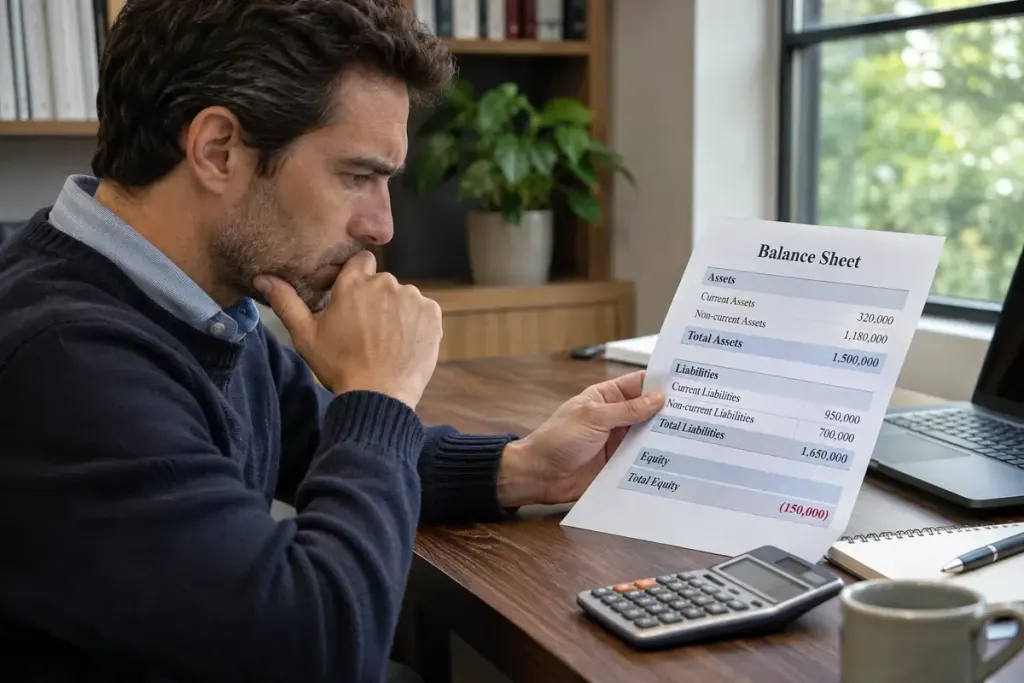
A stock screen sorted from the lowest price-to-book ratio may place negative figures above apparently inexpensive positive ones. That ordering can be arithmetically tidy and economically misleading. A negative denominator changes the interpretation of the ratio.
Price-to-book compares market value with book equity, using consistent total or per-share measures. Aswath Damodaran’s financial-ratio definitions describe that relationship. His discussion of book-value multiples also explains the difficulty created by firms with negative book equity.
Do the arithmetic, then question the ranking
In an invented example, Company A has a market value of 100 and book equity of 50, producing a ratio of 2. Company B has the same market value and book equity of minus 20. A mechanical division produces minus 5.
Minus 5 is numerically lower than 2. It does not mean B is a more extreme version of an ordinary low-positive-price-to-book opportunity. The negative equity has broken that simple ordering. Many data services therefore show the multiple as unavailable or not meaningful rather than displaying a negative value.
Investigate the denominator
Read the relevant financial statements and notes to understand why book equity is negative. Do not infer the entire company’s condition from the sign alone. Also check which reporting date, share class and equity definition the data provider used.
If a screen hides missing values, find out whether companies with negative equity have been excluded. Otherwise, a comparison may silently change its population while appearing to rank the whole market.
For a research note, record “negative book equity; P/B not used for this comparison” instead of forcing the observation into a cheap-to-expensive scale. Other measures may be relevant, but they need their own justification and are not automatic substitutes.
This is a reading principle for financial data, not a recommendation to buy or sell a particular stock. A ratio becomes informative only when its inputs and limitations fit the question being asked.